Decide whether the clip is usable
Pause at the beginning, the strongest movement and the end. Reject an ear that changes shape, a disappearing accessory or a face that returns differently after occlusion. Also watch at normal speed for brief jumps.

Consistency is a review task as much as a prompting task. Identify a few unmistakable features before generation, then check them during movement rather than only in the thumbnail.
Open this shot in the video workspace ↗Opens an editable prompt and settings. Add your own references if needed; nothing is uploaded or generated by this link. Check the current credit estimate before submitting.
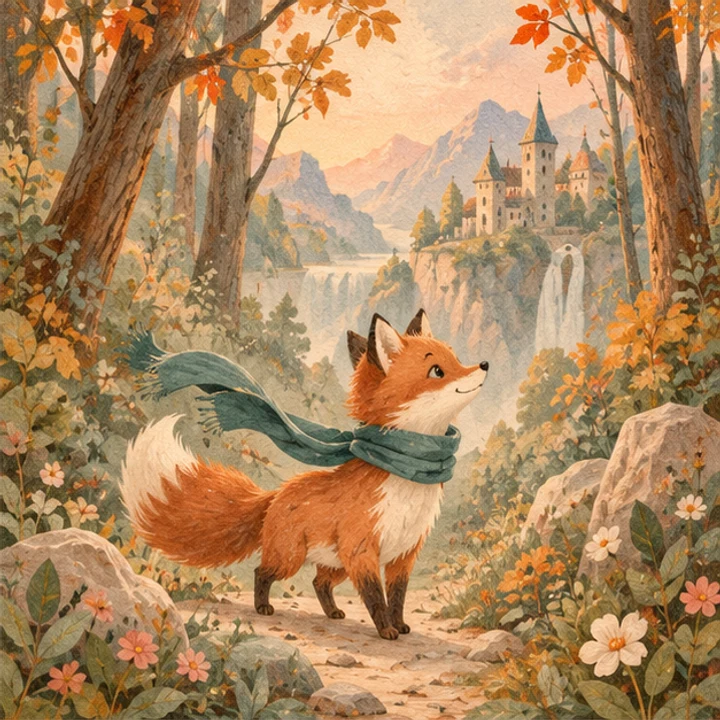
The illustrated fox and scarf provide concrete character cues while the woodland setting supplies room for a small story action.
Compare outline, costume color and body proportions across later images. A still reference does not demonstrate generated motion.
Pause at the beginning, the strongest movement and the end. Reject an ear that changes shape, a disappearing accessory or a face that returns differently after occlusion. Also watch at normal speed for brief jumps.
More references do not guarantee identity. If drift persists, simplify the action and choose a clearer source. A reusable seed can help organize comparisons but does not lock a character’s identity.
For an illustrated animal, note ear shape, muzzle color, clothing and relative head size. Use references that agree on these traits; a mood board mixing redesigns is a weak identity source.
Begin with a glance or a small head movement. Turning away and coming back tests hidden views and can introduce a redesigned face; add it only after a simpler shot works.
A medium fixed shot makes proportions easier to compare. Changing focal distance while the character turns adds another cause of apparent shape change.
Consistency within one clip is the first gate; matching independent clips is a separate task. Approve each shot against the source and against its neighbors. A familiar accessory cannot compensate for a changed face or body shape.
Generate a modest first action and compare the character at the start, at the largest turn and at the ending. Make a small contact sheet outside the generator if it helps you see differences. Once an appearance is acceptable, keep the same reference and identity note for the next shot, changing the action rather than rewriting the whole character.
Create a short identity note: silhouette, face shape, hair or ears, two colors and a distinctive accessory. For the illustrated fox, the orange coat and teal scarf are concrete checks. Avoid mixing different redesigns of the character in one reference set.
Keep the same character, change everything else.
Name distinctive identity cues and keep the first change modest. A broad consistency request does not replace a clear reference and frame-by-frame inspection.
Copy it or open it in the workspace to edit. Replace the subject details to match your own source.
Keep the reference character’s ear shape, muzzle color, outfit and head proportions consistent. The character makes one small glance to the side, then returns to a calm pose. Fixed medium camera, steady painted style and lighting, continuous shot.
Writing example; adapt it to your reference. This is not a claim that these words guarantee an output.
A seed is not an identity lock. Keep it only as part of the saved settings when comparing attempts, and review the actual result. If the source, motion or framing changes, the same seed does not promise the same character geometry. Clear references and modest actions remain important.
Content reviewed: