Have these ready
Use one approved character view and choose two contrasting emotions relevant to the story. Keep lighting and crop stable.

Design and illustration
Choose a few clear emotions and change expression while keeping head shape, colors and costume stable. Compare subtle changes before exaggerated ones.
You choose your own source and review the current cost before generation.

Expressions should affect eyes and posture as well as the mouth. Check that teeth, pupils and accessories do not mutate between variants.
Label expressions only after viewing them without captions. If the intended feeling is unreadable, simplify the pose.
Open my creative starting point ↗Use one approved character view and choose two contrasting emotions relevant to the story. Keep lighting and crop stable.
Create expression candidates and compare them at the same face size. Look at how eyebrows, eyelids and mouth change together while jaw, ears and accessories remain recognizable. Put the preferred expressions beside the neutral reference before using them in a scene.
A readable small expression may serve the story better than an extreme face. If anatomy changes, reduce the requested intensity or redraw the expression in an illustration workflow.
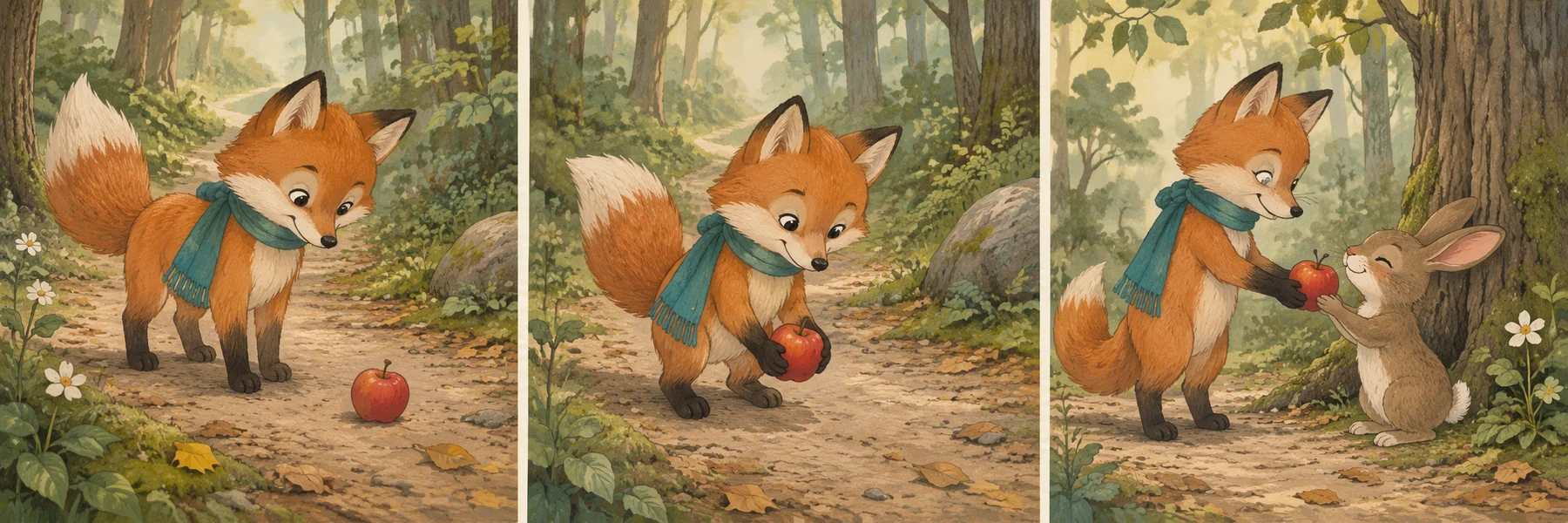
Why consider this directionThe illustrated fox and scarf provide concrete character cues while the woodland setting supplies room for a small story action.
Check before choosingCompare outline, costume color and body proportions across later images. A still reference does not demonstrate generated motion.

Why consider this directionAnother illustrated scene can help you consider how the character occupies space and relates to the environment.
Check before choosingMatch identity cues deliberately rather than assuming a shared storybook label ensures continuity. Inspect scarf, ears and face shape.

Why consider this directionA separate story image offers a composition reference for scale, scene depth and the placement of an illustrated character.
Check before choosingCompare it with the approved character sheet before treating it as part of a sequence. Independent examples are not a verified multi-scene identity test.
No. Subtle changes can communicate clearly while maintaining the character. Compare stable anchors such as eye spacing and nose shape. An expression sheet is useful only if viewers still understand that all candidates belong to the same person.
Content reviewed: